Automation Agency Pricing Models: What Each One Costs You
Automation agency pricing models fall into four main types: project fees, monthly retainers, per-automation subscriptions, and revenue share. Each model changes what the agency is incentivised to do, which affects your cost, risk, and long-term commitment. Knowing the trade-offs helps you pick an agency whose incentives match your goals.
What are the main automation agency pricing models?
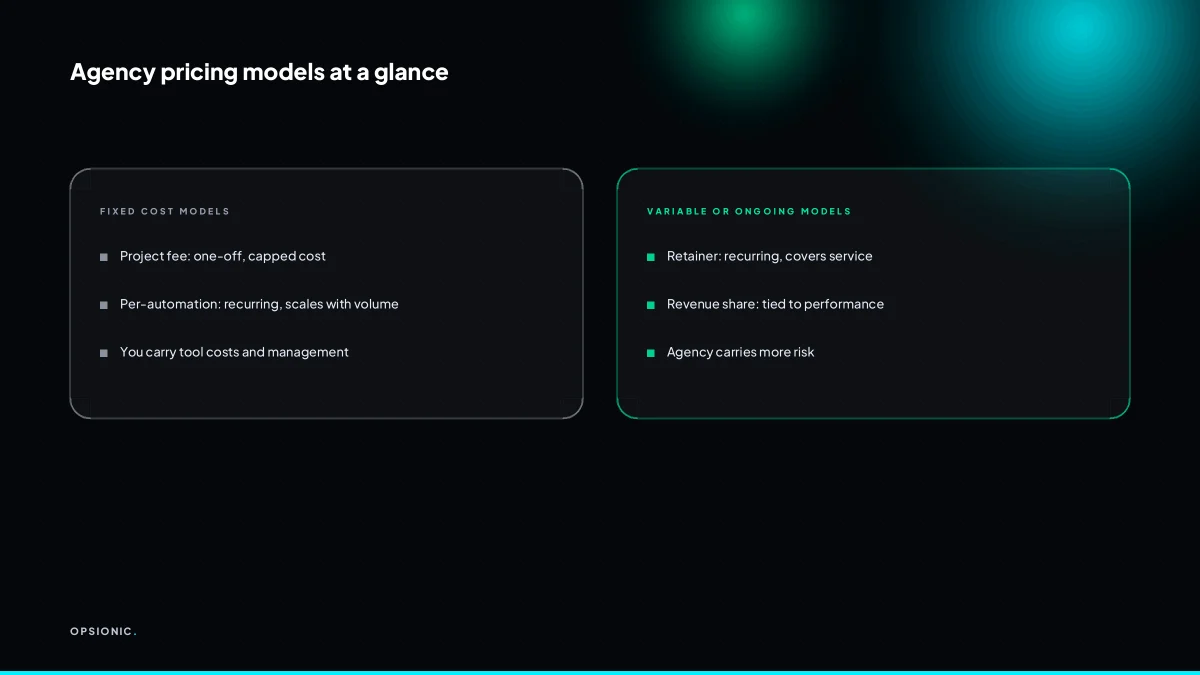
There are four main automation agency pricing models: project fees, monthly retainers, per-automation subscriptions, and revenue share. Project fees are one-off payments for a defined build. Retainers charge a fixed monthly amount for ongoing service. Per-automation subscriptions bill per workflow. Revenue share takes a percentage of the revenue an automation generates.
A project fee suits work with a clear end point. You might pay a fixed sum to connect a booking form to your CRM, test it, and hand it over. The quote lists one price and a delivery date. Once the build is done, the agency’s financial interest ends, which means you own the maintenance burden.
A monthly retainer flips that. You pay a set amount each month, and the agency keeps your automations running, fixes breakages, and builds new small workflows as part of the service. For a small business with several connected tools, this is often the most common model because the work never really stops. Most of what we cover under automation services for small businesses falls into this pattern.
Per-automation subscriptions look like software pricing. Each workflow costs a monthly fee, regardless of how often it runs. This works when you want one or two automations and nothing else. Revenue share is the rarest model. The agency builds something that directly generates sales, then takes a cut of each transaction. The risk sits with the agency, so the percentage is usually high.
For small businesses, retainers and per-automation subscriptions dominate. Project fees appear for one-off builds. Revenue share rarely appears outside sales-heavy funnels.
How does a project fee work, and what does it incentivise?
A project fee is a fixed price for a defined scope, such as building a lead routing automation. It incentivises the agency to finish quickly and move on, which can mean less testing or documentation. For you, it caps cost but offers no ongoing support unless you pay extra. Any change to scope usually triggers a new quote.
Project fees make sense for one-off builds with a clear end point. A single workflow that connects two tools and then runs untouched for a year is a sensible fixed-price job. You know the total before you start, and the agency knows exactly what done looks like.
The risk is scope creep. You ask for one extra field in the middle of the build. The agency adds a condition. Then another. Each request feels small, but the original quote no longer covers the work. The fix is a written brief that names the trigger, the data, the destination, and the failure path. If a request sits outside that brief, treat it as a new quote rather than a favour.
After delivery, check who owns what. You should receive the workflow files, the account credentials, and a short handover note. Support is usually time-boxed or billed separately. Before you sign, ask the questions in this checklist for vetting an automation agency, because a low project fee with no handover can cost more than a higher one with a clean exit.
Here is a worked example, not a client. A small firm pays EUR 900 for a project fee to build an enquiry-to-invoice workflow. The agency spends nine hours: three on scoping, four on building, two on testing and handover. That is EUR 100 per hour. If the same firm later asks for an extra approval step, the agency quotes EUR 180 for two more hours. The original EUR 900 bought a finished, working workflow. The change bought a separate piece of work. That distinction is what a clear brief protects.
Not sure which of these applies to you?
Answer six questions and see what we would automate first in your business, and what it is worth.
What does a monthly retainer include, and why does it change agency behaviour?
A monthly retainer is a recurring fee for a set of services, like maintaining and improving automations. It incentivises the agency to keep you happy month after month, which encourages proactive monitoring and incremental improvements. The downside is you pay even in quiet months, and the retainer may cover more than you actually need.
What you normally get for that fee falls into three buckets:
- Monitoring. The agency checks that workflows still run, that API connections have not broken, and that error logs are clean.
- Changes. When a form gains a field or a supplier changes an invoice format, the agency updates the automation without a fresh quote.
- Support. You can ask questions and request small fixes without watching the clock.
The incentive works in your favour. A retainer pays the agency for continuity, not for finishing a job and leaving. If your automations silently break, you cancel. So the agency has a commercial reason to catch problems early and suggest small improvements before you ask. That is a real difference from a project fee, where the builder is paid on handover and has no income tied to month two.
The risk sits on the other side. If your workflows are stable, a retainer can become a subscription for peace of mind you do not need. A firm that runs one automation and rarely changes it may pay for monitoring that never finds anything. Before signing, ask what the retainer covers in a month where nothing breaks. If the honest answer is “not much”, a per-change or project model may fit better. You can see how we structure the build and handover on our how we build an automation page.
What is per-automation subscription pricing, and where are the hidden costs?
Per-automation subscription pricing charges a recurring fee for each workflow, often on top of the tools it uses. It suits businesses that want to add automations gradually without a large upfront cost. Hidden costs appear when you have many automations, because the monthly total can exceed a retainer, and you still need to manage the tools yourself.
In a proposal this model usually appears as a line item per workflow: one fee for the lead router, another for the invoice follow-up, another for the review request. Each fee looks modest on its own, which is the point. The agency builds the automation, hosts it, and charges monthly to keep it running. You pay for the workflow, not for a person who watches it.
The cumulative cost problem shows up around the third or fourth automation. A single workflow at EUR 49 a month is easy to approve. Five of them is EUR 245, and you still pay for the underlying tools separately. The comparison below shows how the total shifts as you add automations.
| Model | One automation | Five automations | You manage tools |
|---|---|---|---|
| Per-automation subscription | EUR 49 a month | EUR 245 a month | Yes |
| Managed retainer | EUR 599 a month | EUR 599 a month | No |
| Project fee, then you run it | EUR 1,200 once | EUR 4,800 once | Yes |
The third row is the real catch. Per-automation pricing rarely includes tool administration. You still need to log into Zapier or Make when a connection breaks, when an app updates its API, or when a field name changes. The agency fixes the automation it built, but you are the one who notices it failed. If you do not want to learn how Zapier pricing and task limits actually work, that burden lands on your desk every month.
What is this costing you now?
Based on removing half of that time.
When does revenue share make sense, and when is it a red flag?
Revenue share means the agency takes a percentage of revenue generated by an automation, like a booking bot. It makes sense only when the automation directly and measurably drives sales, and the percentage is low. It is a red flag when the agency cannot prove causation, demands a high percentage, or wants a long lock-in without performance guarantees.
The one fair scenario is narrow. A booking bot that takes deposits, fills empty slots, or sells a specific product can be tied to a transaction. If the automation creates a sale that would not otherwise happen, and you can see the sale in your own system, a small cut is defensible. Anything else is a commission on hope.
Mistake one: vague attribution. The agency claims credit for revenue it cannot trace. You see a new lead, but nobody can show the automated email or the bot conversation that produced it. The fix is to refuse revenue share unless the automation logs a unique event, like a booking ID or a payment reference, that your own reporting can confirm. If you cannot audit it, you are paying a story.
Mistake two: the percentage creeps. Ten per cent sounds fine until the volume grows and the agency is earning more than a retainer would have cost, forever. The fix is to cap the total monthly payout at a fixed EUR amount, or to switch to a retainer once volume passes a threshold you set in writing before signing.
Mistake three: long lock-in with no performance floor. A 12-month revenue share deal with no minimum results means the agency gets paid even if the automation does nothing. The fix is to define success before the build: a specific number of completed bookings or paid invoices per month, measured in your system. If the automation misses that number for two consecutive months, you can walk away without penalty. Before you agree to any model, run the numbers with a simple automation ROI calculation so the pricing structure cannot hide a bad deal.
How do you compare automation agency quotes without getting trapped?
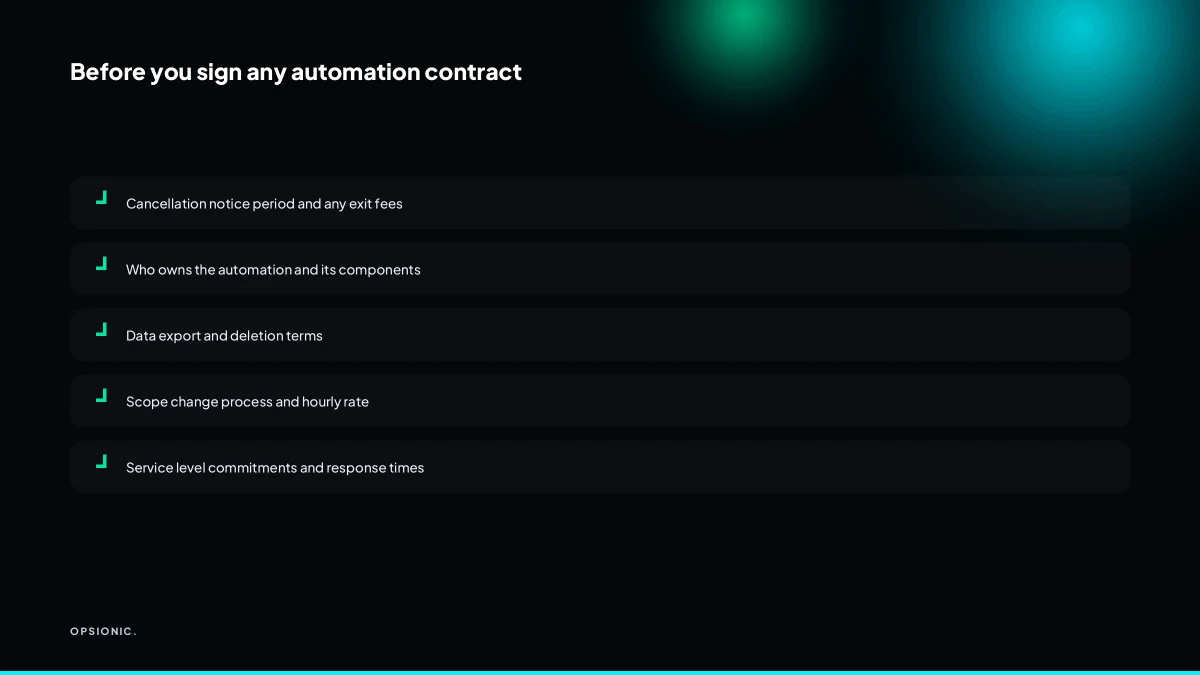
To compare quotes fairly, normalise them: calculate the total cost over 12 months, including setup, tools, and any minimum term. Then check three contract clauses: cancellation notice, ownership of the automation, and what happens to your data if you leave. Finally, ask each agency what they would automate first and why, to test their thinking.
- Calculate the 12-month total for each quote. Add the setup fee, the monthly fee multiplied by twelve, the cost of any required software licences, and the value of hours you still spend on the process. A quote with no setup fee but a higher monthly rate can cost more by month nine than one with a setup fee and a lower retainer.
- Read the cancellation clause first. Look for the notice period and any penalty. A 30-day notice on a rolling contract is very different from a six-month minimum term that renews automatically for another six months unless you cancel by a specific date.
- Check who owns the automation. If the agency builds flows in their own account, you may be renting access. Ask whether the workflows, scripts, and documentation transfer to you if you leave, and whether there is an exit fee.
- Confirm what happens to your data. Ask where your data is stored, who can access it, and whether the agency deletes it on termination. GDPR obligations do not end when the contract does.
- Ask what they would automate first and why. A good answer names a specific process in your business, estimates the hours it consumes, and explains the trigger and the outcome. A vague answer about “streamlining workflows” tells you they have not looked at your business. If you want to hear how we answer that question, book a free plan and ask us directly.
Want this running in your business next week?
A relaxed 20-minute video chat. Camera on or off. You leave with a plan whether or not you hire us.
- No call unless you ask for one
- From EUR 399 a month, no setup fee
- Built and run for you, not handed over as homework
Sources we checked
Questions people ask
What is the average cost of hiring an automation agency?
There is no reliable average, because scope varies so widely. Managed automation at Opsionic starts at EUR 599 a month, or EUR 399 a month for a single workflow, with no setup fee and a six-month initial term. Larger projects get a fixed quote after a free planning chat.
Do automation agencies charge a setup fee?
Some do, some fold the build into the first months of a retainer, and some charge nothing upfront. Opsionic has no setup fee. Always ask what happens if you cancel early, because a waived setup fee is sometimes recovered through a longer minimum term.
Can I cancel a monthly retainer at any time?
It depends on the contract, not the model. Many retainers carry a minimum term, often three to twelve months, because the agency recovers build time across it. Ask for the notice period and the minimum term in writing before you sign anything.
Who owns the automation if I stop paying?
This should be settled in writing before the build starts. If you paid for the build, you should receive the workflow files, credentials and a handover note. If the agency hosts the automation on its own accounts, access usually ends when payment stops, so confirm ownership and export options in advance.
Is revenue share ever a good idea for a small business?
Only in a narrow case: the automation directly creates a sale you can trace in your own system, the percentage is low, and the total payout is capped. If the agency cannot show a booking ID or payment reference proving the automation caused the revenue, walk away.
How many automations do I need to start?
One. Pick the process that costs you the most repeated hours each week, such as retyping bookings or chasing records, and automate that first. Adding more before the first one is stable usually creates work rather than removing it.
What is the difference between an agency retainer and a freelancer's hourly rate?
A freelancer bills for hours worked, so the cost rises with every change and stops when the work stops. A retainer bills a fixed monthly amount for monitoring, changes and support, so the cost is predictable but you pay in quiet months too.