Is AI Safe for Customer Data? GDPR for Small Business
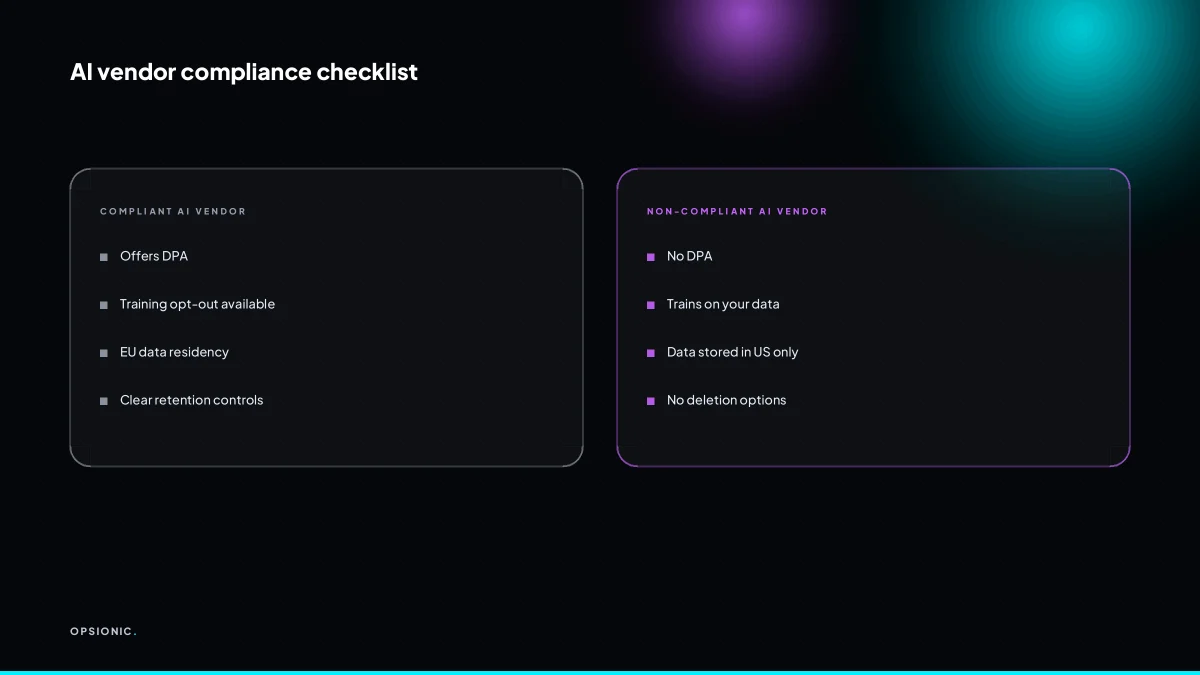
Yes, AI can be safe for customer data in a small business, but only if you treat the AI provider as a data processor and configure it properly. Under GDPR, you remain the controller. You need a Data Processing Agreement, EU data residency or approved transfer safeguards, training opt-outs, and retention controls. Without those, using AI on customer data risks a breach.
What counts as customer data under GDPR when you use AI?
Any information that can identify a living person counts as personal data. That includes names, email addresses, phone numbers, IP addresses, order history, and support chat logs. If the AI tool can see it and link it to a person, GDPR applies.
Many small business owners assume GDPR only covers private individuals. It does not. A sole trader’s work email, a company director’s mobile number, a procurement manager’s name on an invoice: all of it is personal data because a living person sits behind it. The moment an AI tool receives that information in a prompt or an uploaded spreadsheet, you are processing personal data.
Pseudonymisation means replacing identifying fields with codes or tokens. The original data can be restored with a key, so GDPR still applies. Anonymisation is different: the link to the person is gone for good, and the data falls outside the regulation. Most AI workflows never reach true anonymisation because the tool needs enough context to be useful.
In practice, an AI tool processes personal data every time you paste a customer email into a prompt, upload a CSV of leads, or connect an AI assistant to your CRM. The legal question is not whether processing happens. It is who decides why and how, and what safeguards sit around the tool. That is where the controller and processor split matters, and where a gdpr compliant automation checklist becomes the practical starting point.
Am I the data controller or the processor when I use AI?
In almost every small business use case, you are the data controller. You decide why customer data is processed and what the AI does with it. The AI provider is your processor, acting only on your instructions. This matters because the controller carries the primary legal responsibility for GDPR compliance, including choosing a compliant processor.
Under GDPR, the controller determines the purposes and means of processing. The processor handles personal data on the controller’s behalf and has no independent say over why the processing happens. When you paste a customer’s email into an AI tool to draft a reply, you have set the purpose: answering that customer. You have also set the means: this tool, this prompt, this data. That makes you the controller before you have written a single word.
The AI provider is your processor in that moment. It follows your instruction, returns an output, and should not use the data for anything else. You remain responsible for what you feed in and what you do with the output.
There are exceptions. If an AI provider trains its models on the content you submit, and you cannot opt out, the provider is making its own decision about the data. That pushes it toward acting as a controller for that processing. The same applies when a provider uses your data to improve its service or share it with affiliates. Check the provider’s terms and the opt-out settings before you assume the processor role is clean.
Misclassifying roles has real consequences. If you treat a provider as a pure processor when its terms allow training on your data, you may be relying on safeguards that do not exist. If you think the provider is the controller and you are off the hook, you are wrong. The fine, the complaint, and the awkward conversation with the customer all land on you first. For a small business working across borders, a European automation agency that handles VAT, data and support can help you map these roles before you connect a tool to live customer records.
Not sure which of these applies to you?
Answer six questions and see what we would automate first in your business, and what it is worth.
What should a Data Processing Agreement with an AI vendor contain?
A Data Processing Agreement (DPA) must state the subject matter and duration of processing, the nature and purpose, the type of personal data, and the obligations of the processor. It must require the processor to follow your instructions, assist with data subject rights, ensure confidentiality, and delete or return data at the end. Many AI providers offer a standard DPA.
Under GDPR Article 28, a valid DPA has to cover specific ground. It must bind the processor to your documented instructions, let you audit their compliance, and make them notify you of any breach without undue delay. It also has to set out whether they use sub-processors and how they get your approval for them. If a clause is missing, the contract is not just weak. It is non-compliant.
The practical steps are simple. Ask the vendor for their DPA before you sign anything. Read it yourself first, then have someone who understands data law check it. If the vendor is based outside the EEA, confirm they use Standard Contractual Clauses or an adequacy decision. If they refuse to provide a DPA at all, stop. That vendor is not ready for European customer data.
Red flags to look for in an AI DPA:
- Training clauses that are vague. If the DPA says the vendor may use your data to “improve services” without saying whether that means training models, assume it does. Demand a clear opt-out in writing.
- No deletion commitment. The DPA must say how long they keep your data after you leave, and how they delete it. “Commercially reasonable efforts” is not a commitment.
- Unlimited sub-processors. If they can add new sub-processors without telling you, you lose control of where data flows.
- Silence on data subject requests. If a customer asks to be forgotten, the vendor must help you do it. If the DPA does not mention this, push back.
- Liability capped at nothing. Some DPAs cap the vendor’s liability at the fees you paid. That may not be enough when a breach causes significant costs.
If a vendor refuses to sign a DPA, you have three options. Negotiate the specific clauses you need. Switch to a provider that will sign. Or run the tool without customer data, which usually makes it useless. Before you agree to anything, run through the same checks you would for any automation: a practical GDPR checklist for small business automation keeps you from signing a contract that looks fine but fails on page three.
How do data residency and US transfers affect AI compliance?
GDPR restricts transfers of personal data outside the EEA unless safeguards exist. US-based AI providers may rely on the EU-US Data Privacy Framework, Standard Contractual Clauses, or other mechanisms. You must verify which safeguard applies and whether the provider offers EU data residency. Without a valid transfer mechanism, using the tool is not compliant.
The default rule is simple: personal data stays in the EEA unless a legal mechanism covers the transfer. Two mechanisms cover most US transfers. The EU-US Data Privacy Framework lets certified US companies receive data without extra contracts, but it only applies to organisations on the published list and its legal status has been challenged. Standard Contractual Clauses are pre-approved contract terms you sign with the provider, and they remain valid even where the Framework does not apply.
Data residency is the cleaner option where it exists. If the provider stores and processes data on servers inside the EEA, no transfer mechanism is needed at all. Some AI tools offer this, often on higher tiers. Working with a European provider can simplify this further, as working with a European automation agency removes the US transfer question from the start.
| Option | What it covers | Main limit |
|---|---|---|
| EU data residency | Data stays in EEA servers | Often costs more |
| Data Privacy Framework | Certified US companies | List changes, legal risk |
| Standard Contractual Clauses | Contract terms you sign | You must check the provider signs |
| No mechanism | Nothing | Not compliant |
What is this costing you now?
Based on removing half of that time.
Can an AI vendor use my customer data to train its models?
Some AI vendors train their models on customer inputs by default. For GDPR compliance, you must opt out of such training. Many enterprise or business plans include a setting to disable training, but you must verify it is active. If the vendor cannot guarantee no training on your data, you should not use it for customer data.
Training turns the vendor into a controller, because they decide what happens to your customers’ personal data after you send it. That changes your legal position. You are no longer simply engaging a processor under Article 28. You are handing data to a separate controller, which needs its own lawful basis and its own privacy notice. Most small businesses never intended that.
Here is the practical sequence:
- Open the vendor’s admin console and locate the data controls section. The exact location varies by vendor. For example, in some AI chat tools, you may find a setting to disable model training under data controls or privacy settings. Check the vendor’s current documentation for the precise path.
- Switch off any setting labelled “training”, “model improvement”, “human review of prompts” or “retain data for product development”. If a toggle covers both training and human review, turn it off entirely. A vendor that reviews inputs manually may be processing data for its own purposes.
- Check the data retention policy after opting out. Some tools keep inputs for abuse monitoring even when training is off. Ask how long. If the answer is “we keep it indefinitely for safety”, treat that with caution unless they publish a fixed deletion window.
- Write the date, the setting name, and a screenshot into a simple internal log. One page in a shared drive is enough. If a supervisory authority asks how you decided the vendor was compliant, you can show the toggle, the vendor’s documentation link, and the date you checked. This is the same discipline you would apply to a processor agreement.
If a tool has no opt-out on any plan you can afford, do not put customer data through it. The risk is not hypothetical: a vendor training on your inputs may later surface fragments of that data to another customer’s prompt. That is a risk you accepted by choosing the tool. For customer-facing email drafts, the safer pattern is AI-drafted replies with a human sending them, where the AI never sees live customer data at all.
What practical steps make AI use GDPR-safe before the first prompt?
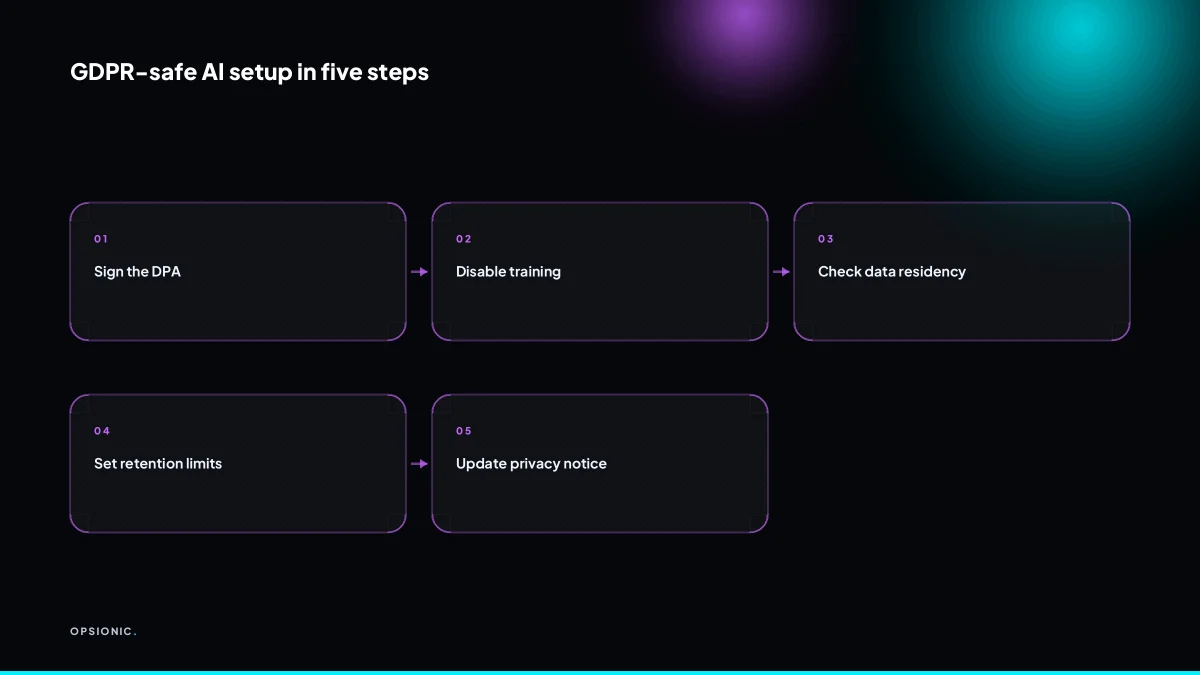
Before sending any customer data to an AI tool, sign the DPA, disable training, check data residency and transfer safeguards, set retention and deletion controls, update your privacy notice, and conduct a Data Protection Impact Assessment if processing is high risk. Document each step. This turns a risky experiment into a defensible process.
Work through this checklist before the first prompt. Print it and keep it with the contract.
- Sign the vendor’s data processing agreement and confirm your role as controller and theirs as processor.
- Switch off model training on your inputs, in every workspace and every user account that touches customer data.
- Confirm where data is stored and whether transfers outside the EEA rely on adequacy decisions or standard contractual clauses.
- Set the shortest retention window the tool allows, and test that deletion actually removes stored prompts and outputs.
- Update your privacy notice to name the AI tool, the purpose, the categories of data, and the legal basis.
- Run a lightweight DPIA: describe the processing, list the risks to individuals, and note the controls above as mitigations.
- Save the DPA, the training opt-out confirmation, and the DPIA in one folder where a future audit can find them.
The goal is not a perfect risk score. It is a written record showing you asked the right questions of your automation provider before any data moved. If the vendor cannot answer one of these points, choose another tool or keep that workflow manual.
Want this running in your business next week?
A relaxed 20-minute video chat. Camera on or off. You leave with a plan whether or not you hire us.
- No call unless you ask for one
- From EUR 399 a month, no setup fee
- Built and run for you, not handed over as homework
Sources we checked
Questions people ask
Do I need customer consent to use AI on their data?
Not always. Consent is one of six lawful bases under GDPR. If you already rely on contract or legitimate interests to handle a customer's order or enquiry, drafting a reply with an AI tool usually fits the same basis. Check your privacy notice names the tool category, and get consent where the purpose is new.
Is ChatGPT GDPR compliant for business use?
It can be, if you use a business plan with a signed Data Processing Agreement, a valid transfer mechanism, and model training switched off in the admin console. Compliance is your configuration and contract, not the product name. Check the vendor's current terms and privacy documentation before sending customer data.
What is the EU AI Act and does it apply to small businesses?
It is EU regulation on AI systems, applied in risk tiers. Most small business uses, such as drafting replies or summarising records, sit in the minimal-risk tier with only transparency duties. Higher-risk uses like recruitment scoring or credit decisions carry more. Check the official EU pages for your specific use.
Can I use AI to draft replies to customer emails without breaching GDPR?
Yes, with three controls: a business plan that excludes training on your inputs, a DPA in place, and a human who reads every draft before it sends. Keep the prompt to what the reply needs. Do not paste in more personal data than the answer requires, and log nothing you would not show the customer.
What happens if an AI vendor has a data breach?
The vendor must notify you without undue delay after becoming aware, as set out in your DPA. You then assess risk and, if it is likely to affect customers' rights, notify your supervisory authority within 72 hours and tell affected customers where the risk is high. Your DPA should set out who does what.
How often should I review my AI vendor's GDPR compliance?
Review at least once a year, and again whenever the vendor changes terms, adds sub-processors, moves data, or changes training settings. Vendors update policies quietly. A diary reminder and a saved copy of the current DPA and privacy notice make the next review a fifteen-minute job rather than a scramble.
Are there GDPR-friendly alternatives to large AI providers?
Yes. Some providers offer EU data residency, and European-hosted models exist. Self-hosting an open model on your own server keeps data inside your infrastructure, though you take on the maintenance. For most small firms the deciding factors are a signed DPA, no training on your inputs, and a clear data location.